UNDER CONSTRUCTION → More to come soon…
Design Goals
I have always loved Action RPGs, from my introduction with Baulder’s Gate: Dark Aliance and Diablo 3 to recent years with Path of Exile and Last Epoch.
To prepare for interviews with a company working on a traditional isometric Action RPG heavily inspired by Diablo and Diablo 2, I decided to try them for the first time. Playing Diablo 1 for the first time really left an impact on me, it felt almost rogue-like and aside from some archaic controls, incredibly modern.
I couldn’t get out of my head, “I could probably build something like that”.
So, I started with some design and production goals.
The project would be limited to 4-6 months of full time solo dev work. The game needed to be small.
Build diversity is paramount, a single class needs to be able to support different play styles.
The deeper into the dungeon you go, the riskier it becomes, and the better the rewards are.
The Core Loop
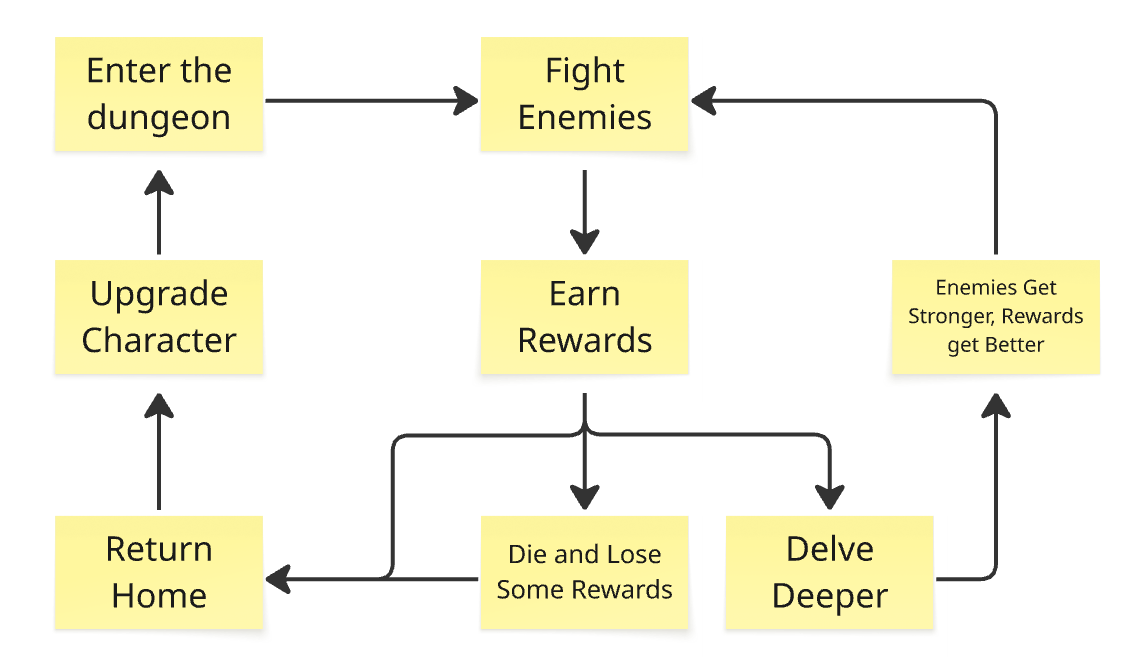
I am not going to pretend that this core loop is a novel by any stretch of the imagination, but it provides me with a core to build on, and poses 3 major questions:
How does the player upgrade their character?
How does the player choose to go home, what do they risk by delving deeper?
How do enemies get stronger and rewards get better?
Character Progression
I wasn’t going to re-invent the wheel here, Action RPGs have answered this question a million times, leveling up, skill points, attribute points, and equiping gear.
The one question core to this game is what was riskless progression and what was progression you could risk by delving deeper into the dungeon.
I landed on XP, attribute points and skill points would be riskless progression, even if the player died in the dungeon any XP collected would not go away. Gear acquired during a run in the dungeon would be dropped on death if it wasn’t equipped.
This would create a way for less skilled players to eventually brute force progression, by earning strength through level ups before they get their first run where they could return home and equip new gear.
Character XP tools
This started very simply:
Defining a TTK arbitrarily that “seemed right”
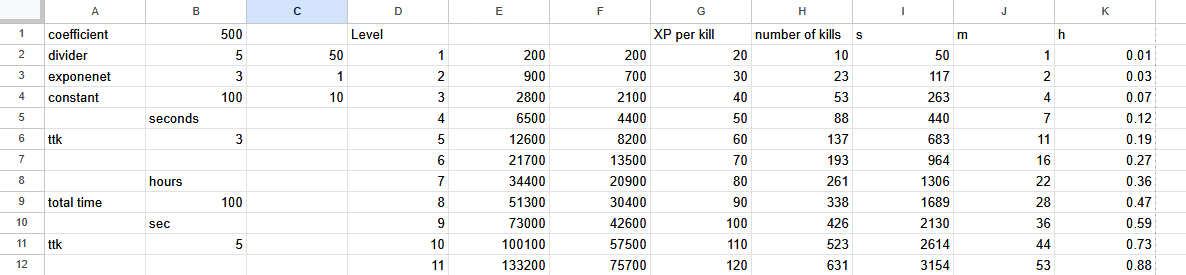
Building a sheet in excel to scale XP required to level based on a curve and scale xp earned.
Boiling that math down into something tangeble: Hours Played.
Arriving on a first pass that looked good.
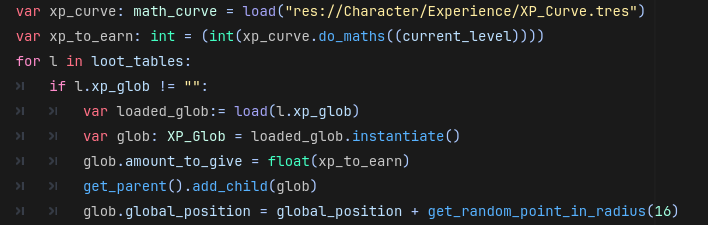
Implement a curve based XP system in godot.
Test the progression, does it feel good? Was the math right? Tweak as necessary.
Skill Points and Skill Trees
Early on I knew the way I wanted to manifest this was similar to Diablo 2, each class would have 4 small skill trees, and share points between them. 3 skill trees would be associated with a corresponding ability and there would be a 4th “passive skill tree” that effected the character globally.
Of the 2 playable classes the core structure of the skill trees didn’t change, but they did go through 3 major iterations.
Dex Wizard First Pass
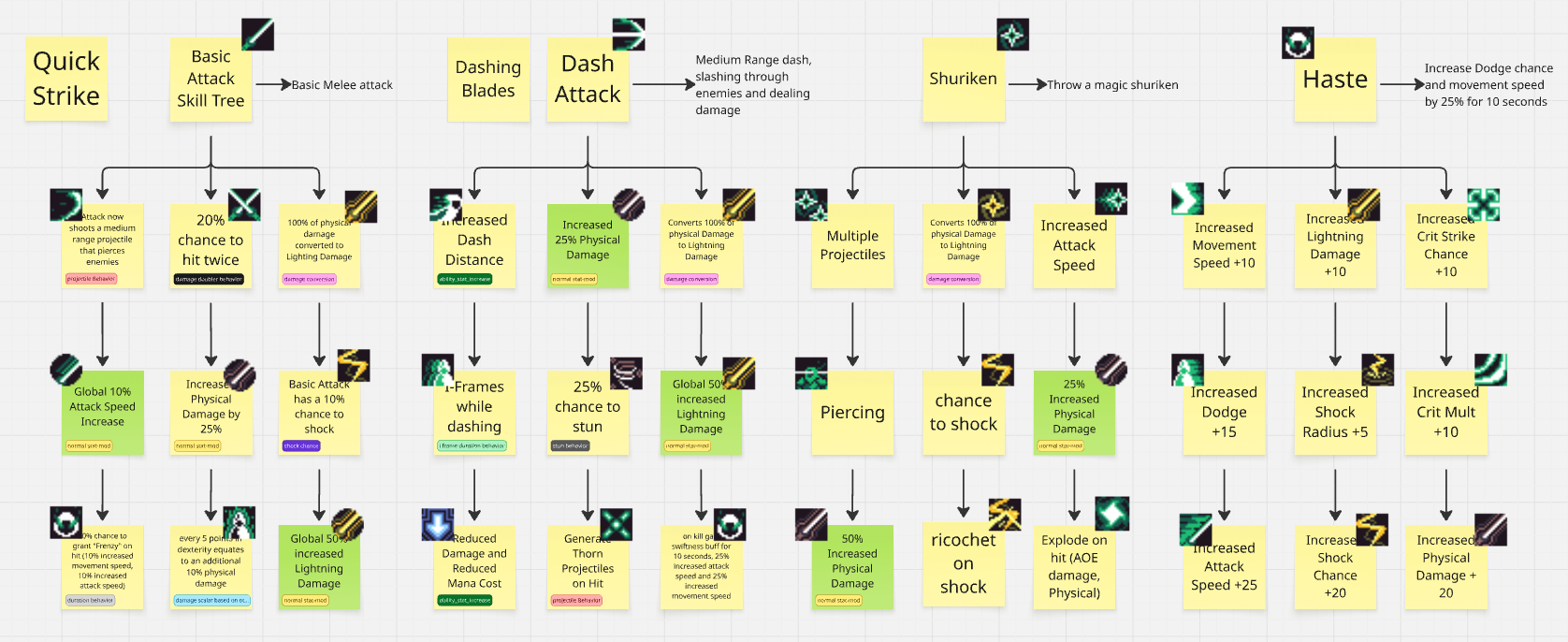
The first pass on the dex wizards skill tree had a few major problems:
Players could brick themselves, “I picked the conversion to lightning and now my damage is worse”. With those options so early in the tree, it felt terrible and left a bad first impression of this avenue of progression.
The shuriken tree was the one that excited players the most, due to the ability behavior modifications it offered, multiple projectiles is a way cooler skill node than 20% chance to hit twice with a basic attack.
The global passive increases in the original skill tree detracted from the core idea of “my build is different than yours”.
Dex Wizard Final Pass
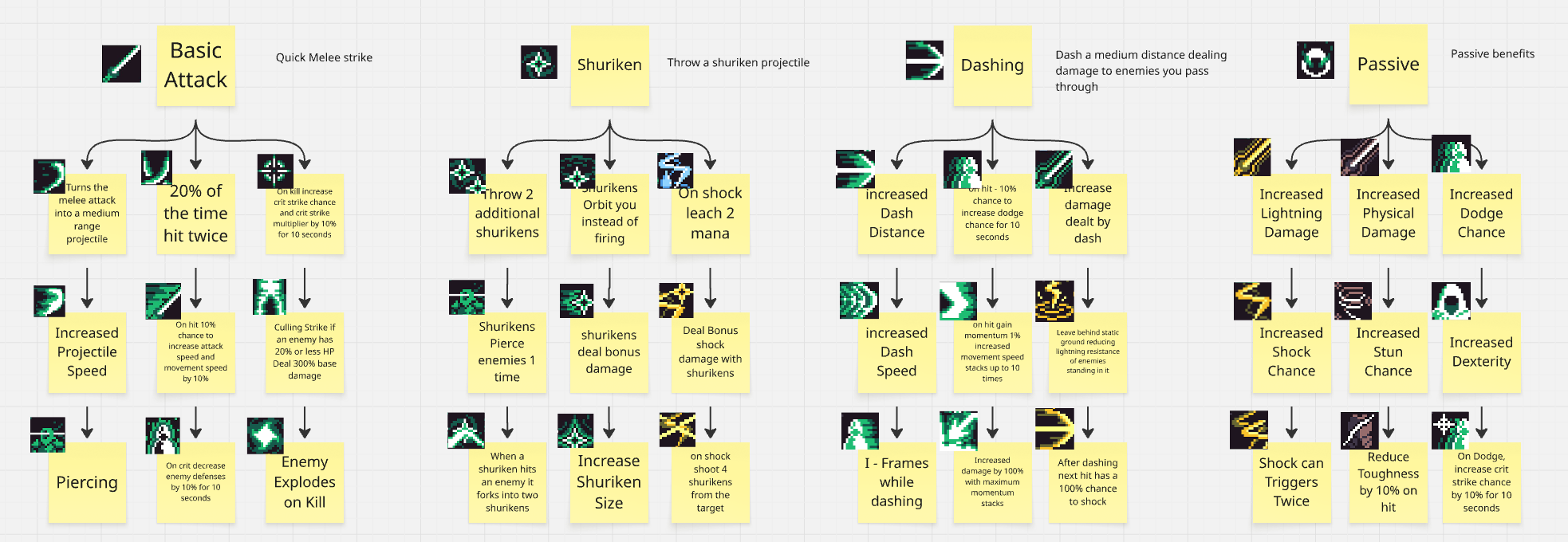
After a few iterations and tweaking, I landed on the final pass solving the problems by doing the following:
Removed “feel bad” nodes, now the base abilities did both physical and lightning damage, so an increase to one or the other would be a net positive no matter what.
Reduced the amount of stat influencing nodes in the skill trees, and leaned heavier into behavior modifications.
Removed all global passive buffs from the ability trees, relegating them only to the passive tree.
These changes had an additional effect of providing more of the percentage of player power to the skill tree as well, reducing a players reliance on gear.
Skill System
Architecting the Skill and Stat system was a major challenge. I had specced systems like this and worked directly with engineers who built them in the past, but the process had always been collaborative, some of the data structures where my idea, some where the engineers, and in the end we would have a feature I could build content with.
I started with research. Youtube videos of how people where making stat systems in godot, trolling reddit, and the godot discord.
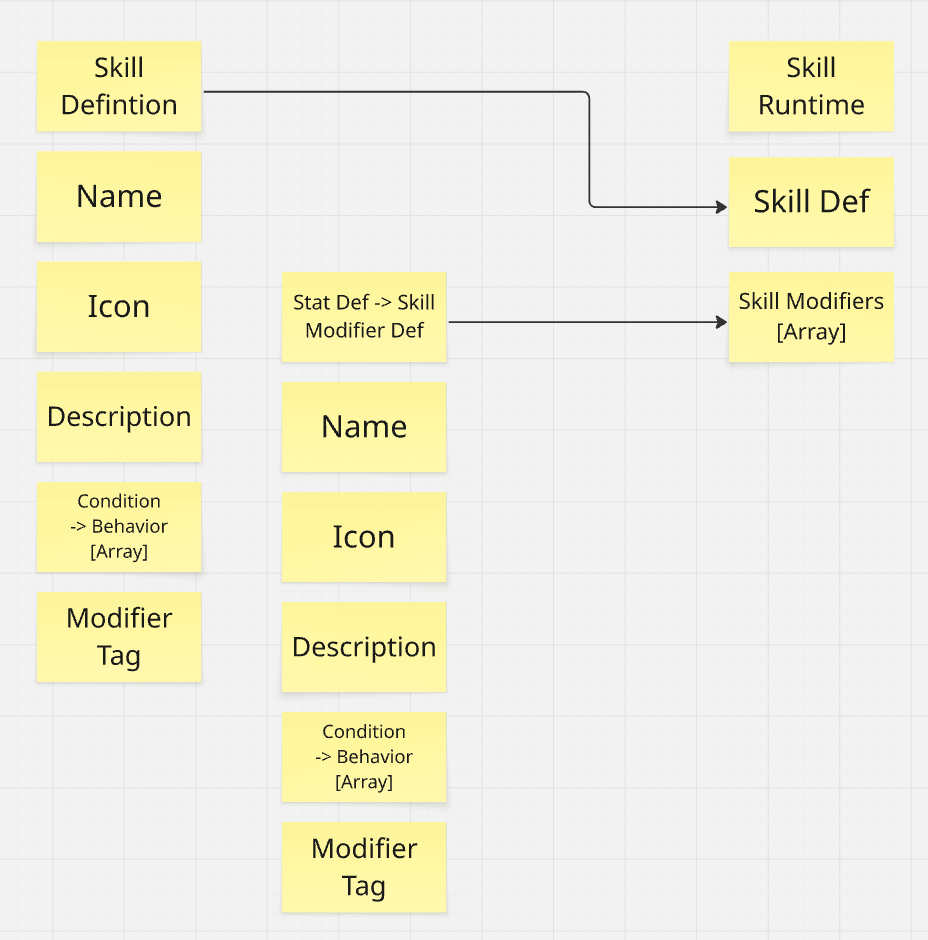
Eventually I came back to how I would have done this if I was working with an engineer, “How do I want to be building skills”. They needed to be modular, there was no way I could build all of this bespoke and finish the game in the time frame allotted. I decided on a skill and behavior system, a skill at its heart was a collection of behaviors with conditions (on cast, on hit, on crit, etc). Each runtime skill would be generic, and on instantiation collect behaviors from its static skill definition and runtime skill modifiers applied through the stat system. Behaviors where atomic and simple, I could script a projectile behavior and re-use it for any projectile I needed if the right variables where exposed.
After a few weeks of research, brute force, debugging, and refinement, I had a skill system that could scale the way I needed it to.